
Leeloo Trading risk calculator
Size every trade on the Leeloo Trading Foundation (LL) $100K from its real capital: the $3,000 max drawdown, not the $100K account. See how many losing trades end the day and the account, then run your plan 10,000 times under Leeloo Trading's own rules.
Your three numbers
- stop after 2 losses
- stop at −$625
Today
Leeloo Trading Foundation (LL) $50KBefore each trade
Leeloo Trading Foundation (LL) $50KYour real capital is $2,500, not $50,000: no daily loss limit is stated, 20 end the account. Size every trade so a normal losing streak cannot reach that limit, and set a daily limit of your own.
The loss side
your edge: +0.13R · $16 a trade on averageThe firm states no daily limit: yours is the only one.
Trailing: the floor rises with your best balance, so after a run of wins it takes fewer.
Over a typical run of 141 trades at a 55% loss rate, a losing streak of 7 or more happens in 63% of runs and one of 10 or more in 14%. The account ends at 20 losses in a row.
| Losses in a row | All lose next | In a day | In 100 trades | In a typical run |
|---|---|---|---|---|
| 2 · Your stopends the day by your choice | 30% | 44% | 100% | 100% |
| 20 · Max drawdownthe account is lost | 1 in 155,864 | — | 1 in 4,213 | 1 in 2,811 |
“All lose next” is the chance that the coming trades are all losers. The other three columns are the chance that such a streak happens at least once: in a day of 3 trades, in 100 trades, and in a typical run of 141 trades (the simulation's median), the streak that ends accounts. All are exact, from your win rate.
The gain side
1 phase · $188 a winNet of losses it takes more trades: the simulation counts them.
Trade by trade at your win rate, under the firm's rules and your limits.
| Winning trades in a row | Chance in a row | What it means |
|---|---|---|
| 16 wins of $188 | 1 in 353,671 | the first target in one go: the one-day rush |
| 8 wins of $188 | 0.2% | half of the first target in one go |
Consistency
10,000 simulated challenges with your numbers
same seed every timeAssumes a fixed stop (−$125) and target (+$188), independent trades at a 45% win rate, the same size every trade, $0 of costs a trade, no slippage; Leeloo Trading's rules as published, checked Sep 30, 2026.
What this does not model
Variable R (stops and targets that move) · partial exits · news gaps · slippage · correlated trades · the firm's discretion · taxes.
The same strategy copied onto several accounts shares one outcome: they pass or fail together, so the odds above do not improve. Trading opposite sides across accounts to push one through (“hedged passing”) is prohibited by the firms that state a rule on it, and this planner never suggests it.
These figures treat each account as its own attempt, the best case, with the chance of one attempt from the simulation above. Each account is bought once: resets are not counted. A monthly plan bills again each month: these figures count the first month of each account.
Every rule this planner applies is published for this account. Other rules (news trading, time limits, a minimum profit for a day to count, scaling) are not simulated: read the firm's own page.
After you pass
Investor Performance AccountFunded from a fresh start, with your numbers: 10,000 runs trade until the first payout can be asked for, the account is lost, or 120 days pass.
- Passday 50
- First payoutday 80
- Second payoutday 110
What this stage publishes
- Profit split
- 100% of the first $12,500, then 90%
- Payouts
- every 30 days
- First payout
- after 30 trading days
- Payout cap
- $1,500 per request, for the first four payouts only
- Minimum payout
- $1,000
- Consistency
- 30%
- Funded account
- no daily loss limit
Every rule this run applies is published for this stage. A day here is a trading day, counted as one day of the firm's own day rules.
Cost to get funded
price, resets, fee after passing1.2 attempts on average: $280 for the first, $85 for each of the others, plus $250 after passing
Nine times in ten one of these 2 attempts passes: $280 for the first, then $85 each time, plus $250 after passing
A reset costs $85: each attempt after the first is counted at that price. a monthly plan bills again each month: this counts the first
Ways to size, compared
your plan 10,000 runs · the others 5,000 each| Way to size | Reached | Account lost | Daily limit hit | Median days |
|---|---|---|---|---|
| Same size every tradeyour plan as set | 82.4% | 11.6% | 0.0% | 50 |
| Half size near the floorwhen less than a third of the drawdown is left | 82.2% | 5.9% | 0.0% | 50 |
| Half size after 2 lossesback to full size after a win | 78.0% | 7.2% | 0.0% | 58 |
| Build a buffer firsthalf size until up half the drawdown | 63.0% | 0.7% | 0.0% | 74 |
The same trades, sized four ways. Half size when the floor gets close is the most common advice: it trades a little speed for fewer lost accounts. The best figure of each column is in accent.
If you risked…
your row 10,000 runs · the others 2,000 each| Risk a trade | Reached | Account lost | Median days | Cost to get funded |
|---|---|---|---|---|
| 1% of the drawdown$25 a trade | 0.1% | 0.0% | 116 | $170,445 |
| 2.5% of the drawdown$62.50 a trade | 47.1% | 0.4% | 89 | $625 |
| 5% of the drawdownyour plan$125 a trade | 82.4% | 11.6% | 50 | $548 |
| 7.5% of the drawdown$187.50 a trade | 74.6% | 25.2% | 28 | $559 |
| 10% of the drawdown$250 a trade | 66.0% | 34.1% | 18 | $574 |
The same win rate, reward, stops and rules at other sizes of risk: only the risk changes. Your own row is the simulation above; the best figure of each column is in accent.
The drawdown floor
trailingIt follows your best balance, $2,500 below it, and never stops rising.
Every new high raises the line for good: keep a fixed buffer and take profits off the table with payouts.
Rushing against your plan
the same win rate and reward| Measure | Your plan | Rushing |
|---|---|---|
| Risk per trade | 5.0% of the drawdown · $125 | 100% of the drawdown · $2,500 |
| Your limits | on | none |
| Reached | 82.4% | 0.0% |
| Daily limit hit | 0.0% | 0.0% |
| Account lost | 11.6% | 100.0% |
| Expected cost to get funded | $548 · 1.2 accounts bought per pass | no run passed |
Rushing sizes each trade so an average day makes the first target in one session ($3,000 in 3 trades, capped here at your whole drawdown: one loss ends the account). This account needs 10 trading days anyway. Same win rate, same reward: only the size and the limits change.
Kelly and the risk of ruin
what the formulas sayKelly = win rate − loss rate ÷ reward = 0.45 − 0.55 ÷ 1.5 = 8.3% a trade, applied here to your real capital, the $2,500 drawdown. Full Kelly grows fastest with deep swings on the way; most traders use a quarter to a half of it. You are at 0.6 Kelly: above half, losing runs get long.
The chance a losing run eats the whole drawdown (20 losses of room) if you traded these numbers without end, on one account.
The real figure for this account: its daily limit and its targets included.
Risk of ruin ≈ e^(−r × U), where U is the losses of room (the drawdown ÷ the risk of one trade) and r solves p · e^(−r × reward) + q · e^(r) = 1 (p the win rate, q the loss rate). Kelly and ruin assume trades of the same size, one after another.
My plan
keep it beside your chart, share it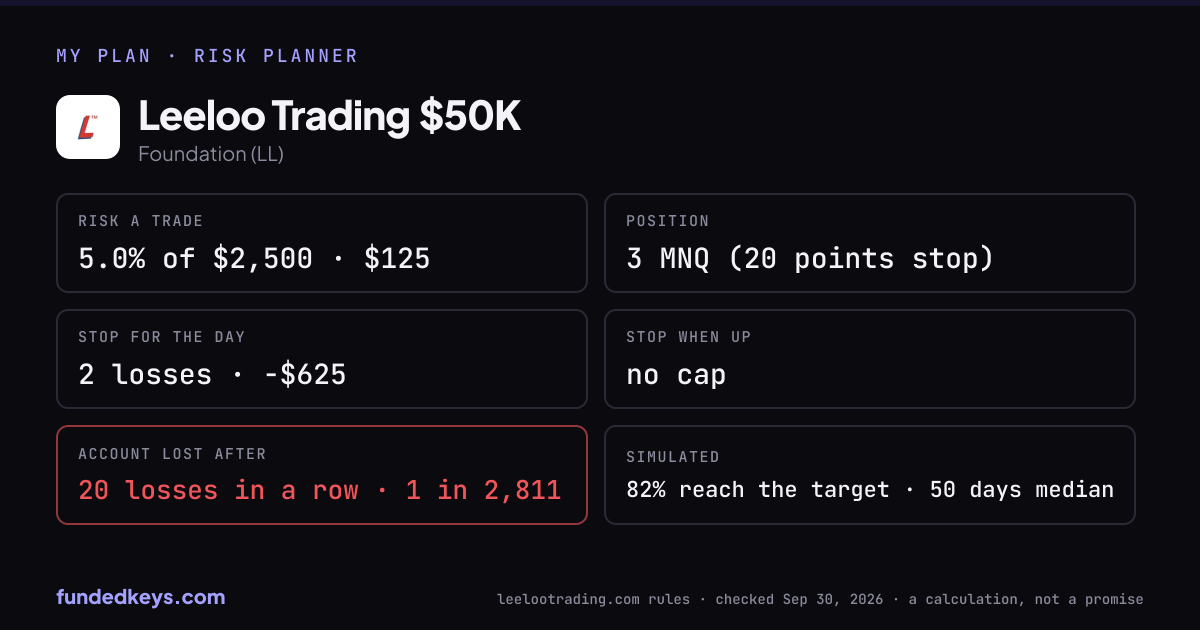
MY PLAN · Leeloo Trading Foundation (LL) $50K
Risk per trade: 5.0% of the $2,500 drawdown ($125) · reward 1.5R · win rate 45% (my estimate)
Position: 3 MNQ (20 points stop)
Stop for the day: after 2 losses in a row or at −$625
Stop for the day when up: no cap
The firm states no daily limit and ends the account after 20 losses in a row (1 in 2,811 over a typical run)
Simulated with these numbers: 82% reach the target, median 50 days
Rules from leelootrading.com, checked Sep 30, 2026 · fundedkeys.com/tools/risk-planner
The card is this plan's share image: posted in Discord, Telegram or X, the link opens this exact plan.
Each run trades your numbers under the account's rules: its daily loss limit, its max drawdown (static, trailing, end of day or locking at the starting balance as the firm states it), its targets, its minimum days and its consistency rule, and under your own limits. A rule the firm does not publish is left out and named. Rules of the accounts are data of Oct 5, 2026. A calculation, not a promise. Check your own days in the consistency calculator
Leeloo Trading risk questions, answered from its rules
How much should I risk per trade on Leeloo Trading's $100K account?
Risk a share of the $3,000 max drawdown, not of the $100K: that $3,000 is what the Leeloo Trading Foundation (LL) $100K can lose before it ends, so it is your real capital. At 5% of it a trade risks $150 (0.15% of the account); 2.5% is $75 and 10% is $300. With a 45% win rate and rewards of 1.5R, 59% of 10,000 simulated runs reach the target and 16% lose the account. A calculation, not a promise.
How many losing trades in a row end the day or the account on Leeloo Trading's $100K account?
Leeloo Trading states no daily loss limit on this account, so only the max drawdown ends it: at 5% of the drawdown a trade ($150), 20 losses in a row reach the $3,000 max drawdown. Trailing: the floor rises with your best balance, so after a run of wins it takes fewer. Over a typical run of 237 trades at a 55% loss rate, a losing streak of 8 or more happens in 59% of runs and one of 11 or more in 13%; a streak of 20 has a 1 in 1,580 chance of happening in such a run.
Does Leeloo Trading have a time limit or a consistency rule on the $100K account?
Leeloo Trading states no time limit for the Leeloo Trading Foundation (LL) $100K. There is no consistency rule. At least 10 trading days are required.
What does Leeloo Trading's $100K account cost to get funded, with retries?
The Leeloo Trading Foundation (LL) $100K costs $320 (list price). A fee of $250 is paid once, after passing. At the opening plan (5% of the drawdown a trade, 45% wins, 1.5R), 59% of attempts reach the target: 1.7 accounts bought per pass. Counting each retry at $85 (retries at the $85 reset), the expected cost is $630, and $740 covers 3 attempts, enough to be funded nine times in ten. It is a monthly plan: it bills again each month, and these figures count the first month only.
Rules and sources: Leeloo Trading review · Risk planner for every firm · consistency calculator · methodology